
Being Readers
Learning to read is crucial and must be prioritised if we are to maximise life opportunities for all our children at St Stephen's Juniors.
Becoming a fluent, skilled, and attentive reader starts at the earliest stages and is driven by the quality of talk that children are exposed to, together with children's experiences of being read to. Which is why it is a focus in our curriculum, including book related talk which introduces children to language that they may not hear in ordinary conversation.
Research has identified that children by the age of 5 years old:
- who had never been read to would have heard 4,662 words
- who were read to 1-2 times per week would have heard 63,570 words
- who were read to 3-5 times per week would have heard 169,520 words
- who were read to daily would have heard 296,660 words
- who were read 5 books each day would have heard 1,483,300 words
Most children do not develop the ability to read without direct teaching. For children who begin school with a poor understanding
of language, being able to decode words is essential for equality, because their understanding of language, their vocabulary and their knowledge of the world will expand rapidly when they can read for themselves.
Children need both good language comprehension and good word reading to become good readers.
Our aim as a Trust is to ensure that all children can read fluently by the end of primary school so that they are ready for their next stage of education.
What is reading?
Our curriculum:
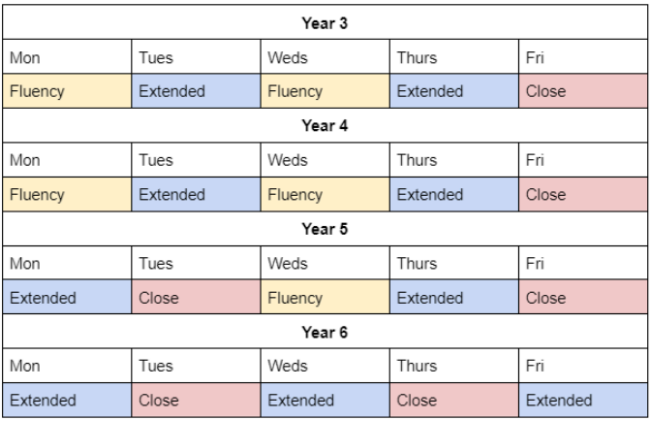
Reading sessions are 30 minutes long every day and are split into three areas- fluency, extended and close.
Every session will use a class text that is age appropriate and linked to the enquiry curriculum where possible.
- Fluency: An extract of 100-200 words read in 1 minute to practice fluency. The class teacher reads a modelled example with prosody and expression. Children are then in mixed ability pairings where they practice reading the extract for fluency.
- Extended: Each child use a physical copy of the class book and follow along with the class teacher reading a longer chunk of text. When reading, there are a range of questions built into discussion.
- Close: An extract of the class book that has already been read is looked at in closer detail. This session is oracy based and delves deeper into the themes of the class book.
Below is a guideline of the sessions within the school week. However, if a class or year group needs more fluency sessions these will take priority.
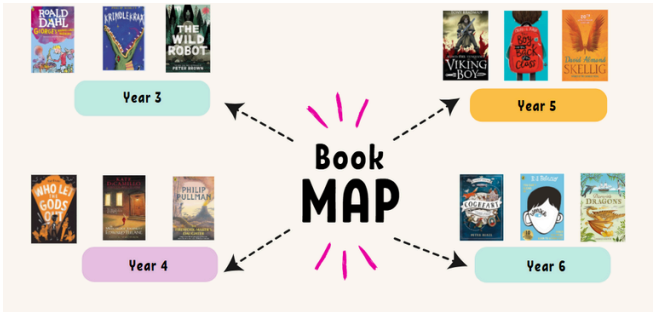
Below are the class books that are used in each year group across the year. The books are chosen to be age appropriate and engaging for the year group. Where it does link, the class book will be linked to the enquiry and writing outcomes.
Assessment:
At the start of Term 2, 4 and 6 children are assessed for fluency using the year group expectations from Collins big cat assess fluency in reading. They will be asked to read a section of text for 1 minute and the fluency will be recorded. From this information, a scheme book that has been carefully matched to their fluency level will be given to the child to read at home.
If your child is reading below their year group fluency expectations, assessments will be completed on a termly basis. If they are working significantly below fluency expectations, children will be read with on a twice weekly basis and will have additional fluency interventions.
Individual Reading:
Those children receiving a phonics intervention will be sent home with a phonetically decodable book from the Little Wandle scheme. This book will target specific sounds which have been identified and taught within their phonics sessions in School. Every day, pupils will have a whole group reading session at school- where the book will be practised and revised with their phonics teacher. They will then take the book home to read for one week. This will ensure that pupils apply their phonics knowledge and read fluently.
Children who are on non-decodable books will move through the colour bands (orange-pearl) determined by fluency assessments. These fluency assessments are used to ensure children are on the correct reading level and pupil progress can be monitored and assessed accurately. The Book Band system helps us to grade our books by difficulty level. Each level has its own colour and includes a selection of different reading scheme books and ‘real’ books. The difference between each band is gradual so that children will not experience difficulty when moving from one to the next. This chart gives an indication of the range of
Book Band levels at which most children will be reading as they progress through the school.
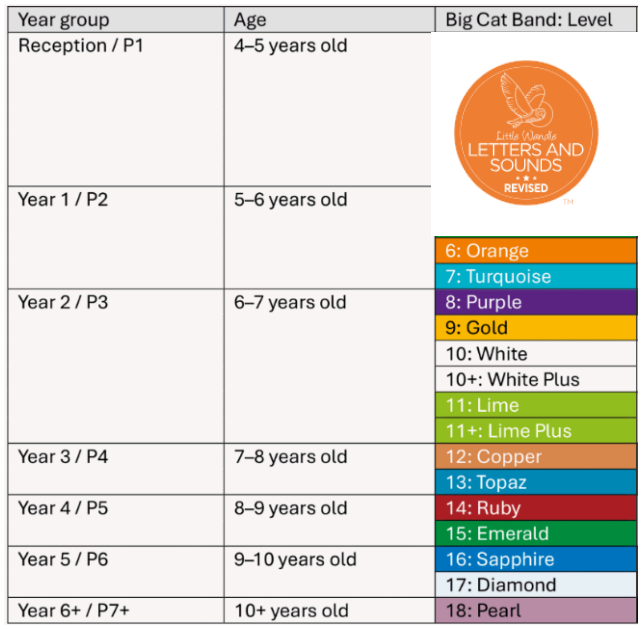
The higher the band, the more challenging the text. Books become longer, with more difficult vocabulary, deeper themes, and greater opportunities for critical thinking. The chart shows the Book Bands for an ‘average’ group of children but children are all individuals who learn and make progress at different rates so the chart is only a guide. As well as periods of rapid progress, your child will probably have periods of consolidation when progress is not as obvious. Although your child maybe of a certain chronological age, they may be reading a book band colour that is before or after their age group as it is matched to both their current level of decoding and comprehension.
Reading for pleasure:
Reading for pleasure is an essential part of our reading ethos. All children have an extended slot in the school library weekly where they can pick a reading for pleasure book to enjoy in their classrooms. Each classroom has a dedicated reading corner where there are a range of fiction and non-fiction books, including books based on their current enquiry.
Each week, every child will have an extended slot in the school library. The time is spent exploring the range of books, sharing with eachother and reviewing their books through discussion or written form.
The library has three main sections;
- Reading for pleasure- fiction books organised into age groups for children to take back to their class to read during the school day. These books do not go home.
- Curriculum- a range of fiction and non fiction books based around different areas of the curriculum including science, art and history.
- Global Goals- To support our whole school understanding and knowledge of the global goals, we have a range of fiction and non fiction books organised into each global goal.
We welcome donations for our school library for a new and exciting selection of books. There is an amazon wishlist with books specifically picked by the children or within our curriculum and global goals on the school website. If you wish to donate a book to the school library for your child’s birthday, it would be warmly welcomed.
Home Reading:
The expectation for reading at home is at least 3 times a week, however reading more often will help your child to progress. We do not have reading records to record reading at home as we want the focus to be around fluency and discussion around the book.
Scheme reading books can be changed once a week and children will be encouraged to read a range of different text types and genres within their colour band.
Reading for pleasure is of upmost priority, therefore reading for their interest at home is encouraged. This may take the
form of a book, graphic novel, comic, magazine or instructions.
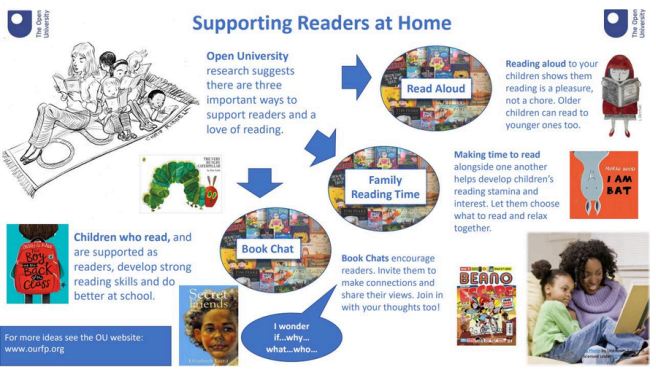
The document below gives prompts to aide discussion during the shared reading experience. For further tips visit this website: https://www.booktrust.org.uk/books-and-reading/tips-and-advice/
How to help at home: